


Mesa Dual Rectifier vs. ENGL Fireball 100 – Two Dream Amps, One Winner
Aubrey Singer | Jul 16, 2010 | Comments 9

BOOGIE DUAL RECTIFIER VS. ENGL FIREBALL 100.
TWO DREAM AMPS, ONE WINNER.
by Aubrey Singer for TheToneKing.com
In the event that you find yourself at your local music store comparing the 2010 Mesa Boogie Dual Rectifier with the new ENGL Fireball 100, pinch yourself. Because you’re dreaming. The likelihood of finding these awesome tone blasters side by side is about as unlikely as seeing John Petrucci bow down to Chris Broderick (or vice versa for that matter). So instead, pledge some allegiance to The Tone King for arranging an exclusive face off between the giant, Boogie, and the ascendent beast called Engl.
As you’ll hear in the demo, close your eyes and you’ll discover that each head becomes the tonal doppelganger of the other (note to self: Doppelganger = cool name for metal band). They both sport the same sticker price, and they’re built for professional shredding. So which one deserves your money? If you’re lucky enough to seriously consider that question, you first need to: A) send me a few grand ‘til times get better, and B) keep reading while taking your pulse. When it spikes, say hello to your new best friend and your neighborhood’s worst enemy.
Let’s start with the 2010 Dual Rectifier. Marshall notwithstanding, no amp brand has made a more indelible mark on rock and metal than Mesa Engineering, and they’ve got the pros to prove it. Check their site. Instead of a list of players you get a drop-down menu.
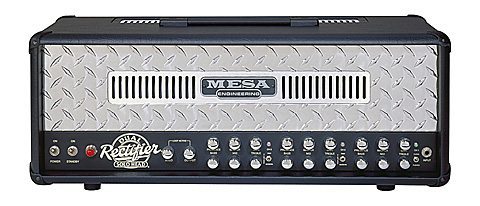 When the Single and Dual Rectifier first hit the strip way back when, Mesa Engineering made history by basically reinventing the alchemy of true “gain.” The humbucker had a soul mate and pedalmakers had a nervous breakdown. Today, the 2010 Mesa Boogie Dual Rectifier captures all that and then some. It’s a testament to 20+ years of Mesa Engineering genius crammed into a head that’s not going anywhere for the next 20+ years thanks to some outstanding features. This includes the choice between going with tubes or solid state rectifier (hence Dual Rectifier). The manual suggests the tube setting; after all, that’s the tonal foundation of the whole Mesa Boogie brand. But if you’ve lost some hearing in the upper register, the silicon diode rectifier punch might be exactly what you’re after. Then you’ve got channel options. Channel 1 gives you the choice between “clean” and “pushed” for a nice, tight crunch, while channels 2 and 3 cover more familiar gain terrain, the latter of which is perfect for ear-shattering Nu Metal tones. (We, at The Tone King, prefer channel 2’s classic warm, creamy Boogie tones that remind us of getting laid for the first time to Night Ranger). And, of course, the piece de resistance is Mesa’s patented Multi-Watt™ power amp that lets you assign either two or four tubes to each channel, which you can select via the accompanying footswitch. It’s no wonder most Rectifier players tend to eschew distortion or fuzz pedals, letting the head do the heavy lifting. Overall, this amp is for tone chasers, pure and simple. It’s all about discovering a great tone, while knowing an even better tone lurks around the dial. Just like the dudes at Mesa Engineering, the guys who play through Boogies tend to strive after tone to the point where it becomes a mythic struggle between man and knob. To the rest of us, it just sounds killer.

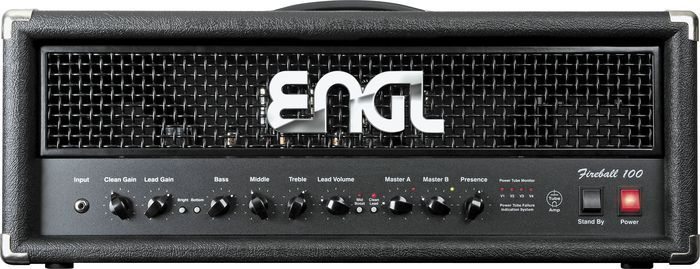 While Mesa’s rise was fast compared to Marshall, Engl’s ascension has been nothing short of meteoric compared to Mesa’s. They nailed it right out of the gate thanks to a lot of road paving by brands like Marshall and Mesa. It’s a smart play that just got a whole lot smarter (and louder) with the launch of the ENGL Fireball 100.
With Engl, great tone is objective, not subjective. This understated confidence is beautifully expressed by the Fireball 100. This isn’t an amp that throws everything at the player to see if it sticks. It knows killer tone and delivers it, instantly, without getting in the way of its own brilliance. That takes smarts and balls in equal measure, and you gotta give it up to Engl here. Some examples: You’ve got clean and gain channels, but the clean channel offers a bright switch. Great idea. Nothing is more annoying than trying to nail some dynamics with a muddy clean channel. Then there’s the bottom switch for adding low-end punch to your clean channel or lead. Because what’s the first thing to go when you boost for lead? Exactly. And for those of us who love nice, honking mids (like this TheToneKing.com writer), the Fireball 100 sports a mid-boost switch (also accessible via footswitch) for added punch that carves out a nice space between the bass and drums.
At the risk of being totally presumptuous (or heretical) I think Randy Rhodes would’ve loved this head. Like Engl, Randy knew, to the nth degree, what great tone was all about, and I think Engl is a kindred spirit in this regard.
In fact, Engl is already amassing an impressive following of next-gen guitar heros, like Chris Broderick, a good example of the player Engl is after – someone who prefers to spend time on their chops and less time tweaking. Why? Because they’ve already got their tone figured out. They simply need a co-pilot who will get them there without needing a detailed flight plan.
If you’re still wondering, consider this: the Dual Rectifier’s user manual is 38 pages. The Fireball 100’s is 11 plus a cover page. Either way, The Tone King knows there is no wrong move, and you can see (and hear) the proof yourself. The Dual Rectifier is about discovery. The Fireball 100 is about accessibility. And so the winner is… you. Mesa Boogie or Engl, you’re playing with the stuff that tone dreams are made of, backed by power that’s nothing short of a nightmare for your neighborhood. And if your head goes missing in the middle of the night, chances are, I’m your neighbor. Lucky me.
Tiny URL for this post:

Filed Under: Amps